It is the last week of September, which means we are having the same conversation eight or nine times a week. A homeowner is thinking about selling, autumn is arriving, and someone has told them the spring market is better.
So they ask the reasonable question. Should I list now, or wait until April?
Almost nobody answers it with numbers. Here are the numbers.
What the benchmark actually did last winter
The MLS® Home Price Index benchmark is the right measure for this question, because it tracks what a comparable home is worth rather than what happened to sell in a given month.
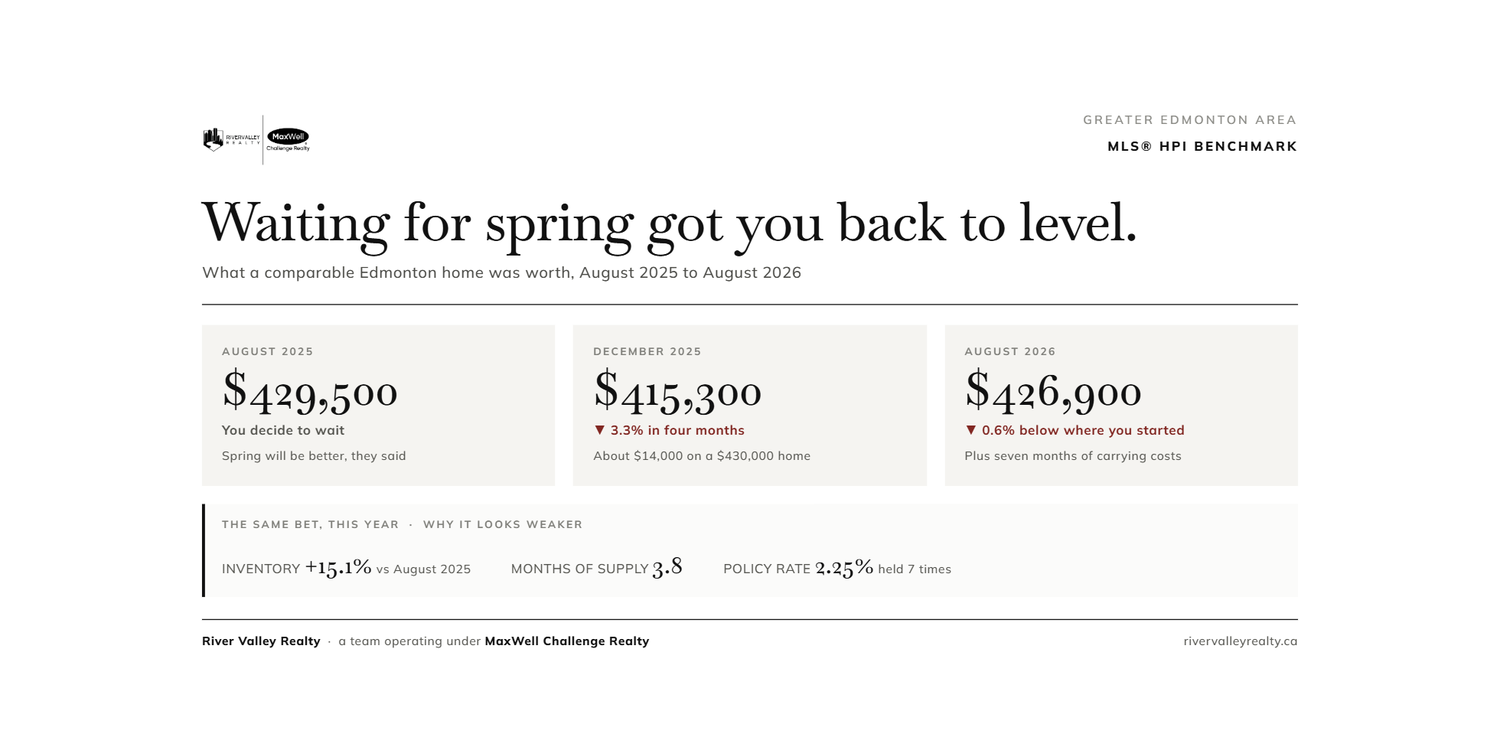
In August 2025, the Greater Edmonton Area benchmark sat at roughly $429,500.
By December 2025 it had fallen to $415,300.
That is a decline of about 3.3 per cent over four months. On a $430,000 home, roughly fourteen thousand dollars of paper value, gone by Christmas.
If the story ended there, "wait for spring" would be obviously right. It does not end there.
What spring actually gave back
The benchmark bottomed out around December and January, then climbed through late winter and into the spring market, peaking in the April and May range before easing again through the summer.
By August 2026 it was $426,900.
Read those three numbers together, because this is the part that matters. A seller who looked at the market in late summer 2025, decided to wait for spring, and sold in the strongest part of 2026 did not come out ahead of where they started. The benchmark in August 2026 is 0.6 per cent below where it was in August 2025.
They took a full winter of risk, paid a full winter of costs, and landed roughly level.
The cost nobody puts in the spreadsheet
Waiting is not free, and the carrying cost is the part sellers consistently leave out.
Seven months of mortgage interest, property tax, insurance, utilities and maintenance on a home you have already decided to sell is real money leaving your account every month. On a typical Edmonton home that is comfortably into five figures over a winter.
Then there is the part that is harder to price. If you are buying as well as selling, you are exposed on both sides of a moving market for the whole period, and a spring market that lifts your sale price lifts your purchase price too. Selling higher into a market where you also buy higher is not the win it looks like on the listing side alone.
Why this year's version of the bet looks weaker, not stronger
"Wait for spring" is a prediction that next spring will be better than this autumn. Three things in the current data make that a harder case than it was a year ago.
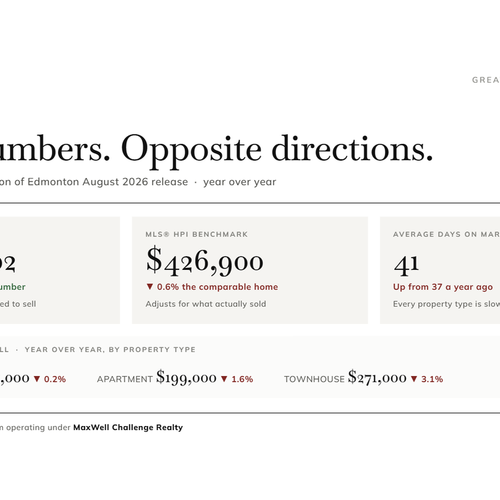
Inventory is materially higher. The region carried 8,052 active listings in August 2026, 15.1 per cent more than August 2025, at 3.8 months of supply. Inside the City of Edmonton it was 4.2 months. More competition in the spring is not a reason for prices to rise.
The starting point is lower. The benchmark entering this autumn is already below where it was entering last autumn. The seasonal dip, if it repeats, starts from a lower shelf.
The board itself flagged it. In the August release, the association's own commentary noted that supply is ample, and that unless demand keeps pace there could be downward pressure on prices beyond the usual seasonal patterns. That is the market's own governing body saying the ordinary autumn slowdown may not be the whole story this year.
The rate assumption hiding inside the plan
When people say they will wait for spring, they usually mean they expect borrowing to be cheaper and buyers to be more plentiful. Worth checking that assumption.
On September 2, 2026 the Bank of Canada held its policy rate at 2.25 per cent, the seventh consecutive decision without a change. The Bank noted that CPI inflation has been running near 3 per cent, largely on gasoline, and pointed to increased upside risks to inflation alongside uncertainty from tariffs. The next scheduled decision is October 28.
That is not a central bank signalling imminent cuts. It is a central bank holding and watching, with one eye on inflation coming back up. Planning your sale around cheaper money in April is a bet, and it may be a fine one, but it should be made knowingly rather than assumed.
We are not mortgage professionals and we are not going to pretend to forecast rates. Your broker can tell you what is actually available to you today, which is a better input than anyone's guess about spring.
When waiting genuinely is the right call
This is not an argument that everyone should list in October. Sometimes waiting is clearly correct.
- Your home shows badly in winter. If the selling feature is a garden, a south facing deck or a view that disappears under snow, spring photographs will do real work for you.
- The work is not done. Listing unfinished beats waiting only in a hot market. This is not one. If six weeks of work meaningfully changes the product, do the work.
- You have nowhere to go. If your purchase depends on spring inventory that does not exist yet, selling first into an uncertain winter puts you in a weak position.
- You do not actually need to move. If the sale is optional, sitting out a soft patch is a legitimate choice. The cost is carrying the property, and if that cost is comfortable, waiting is defensible.
What is not a good reason is a general belief that spring is always better. Last winter's numbers show a seller who waited got back to level, not ahead.
The autumn window is narrower than people think
If you do list this fall, timing inside the season matters. Buyers who want to be in before the holidays are working backwards from a closing date, which means late September and October listings catch a motivated audience. By late November, the buyers still looking are either very serious or very opportunistic, and the second group makes offers accordingly.
A home listed in early October with a correct price has a genuine run at a pre holiday close. The same home listed in late November is realistically a February sale, and it will have accumulated days on market that follow it into the new year.
What actually decides this
Not the calendar. Your situation, your property type and your neighbourhood.
Some Edmonton communities barely have a seasonal pattern. Others swing hard. A benchmark that fell 3.3 per cent region wide last winter fell by more in some places and by almost nothing in others, and the only way to know which one you are in is to look at your community rather than the region.
That is the number we would pull before advising anyone either way: what your property type in your neighbourhood actually did between September and April over the last few years, and what is sitting unsold there right now.
Reach out to River Valley Realty for a consultation with no obligation attached. If the numbers say waiting is the better move for your situation, we will tell you that, and we will show you why.
Benchmark and inventory figures from the REALTORS® Association of Edmonton monthly market releases. The August 2025 benchmark is derived from the August 2026 benchmark of $426,900 and the 0.6 per cent year over year decline the association reported. The December 2025 benchmark of $415,300 is from the association's December 2025 release. Policy rate and inflation commentary from the Bank of Canada interest rate announcement of September 2, 2026. Nothing here is mortgage, tax or financial advice. Information is deemed reliable but not guaranteed and should not be relied upon as a substitute for advice on your specific circumstances.
River Valley Realty is a team operating under MaxWell Challenge Realty, serving Edmonton and surrounding communities.
Check out this article next