
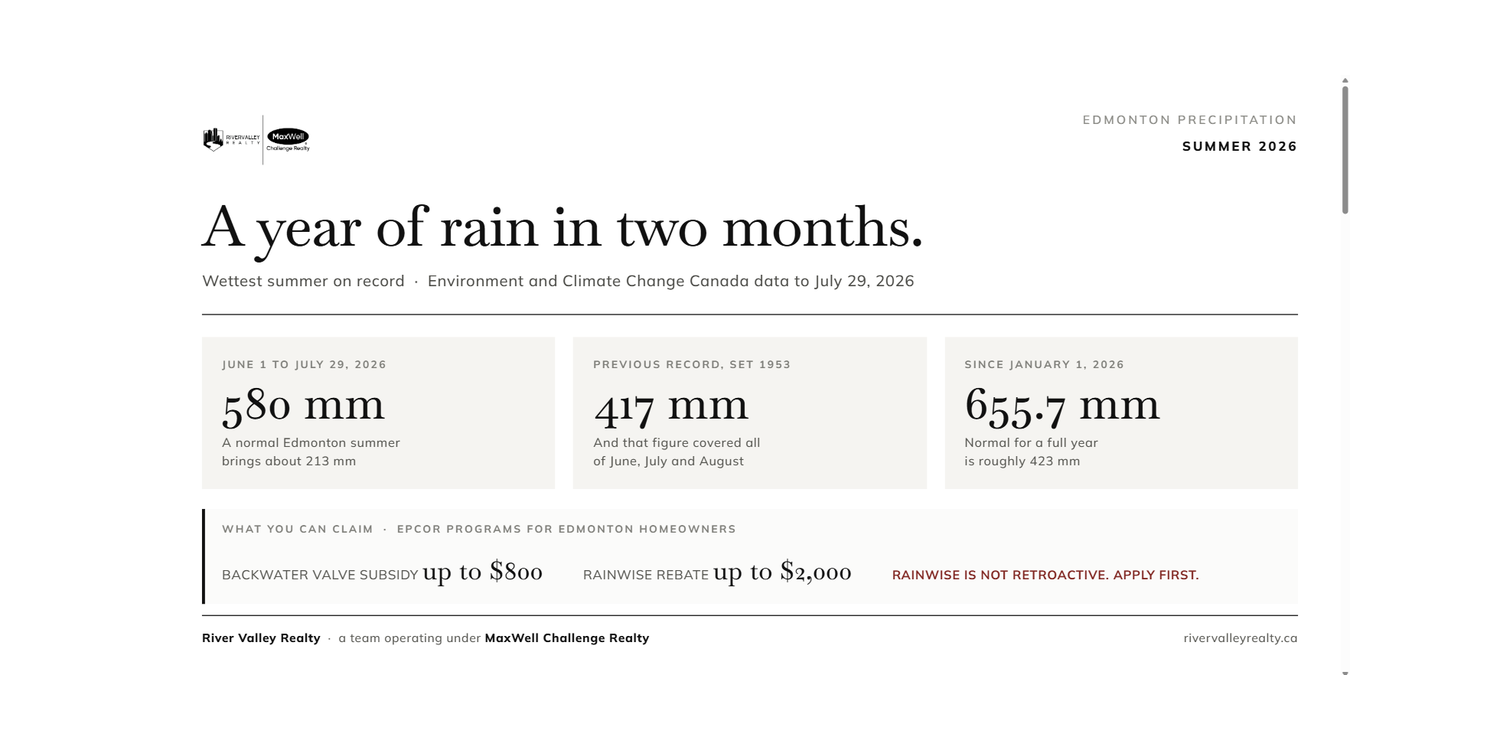
By the end of July, Edmonton had recorded 580 millimetres of rain since June 1. A normal Edmonton summer brings about 213 millimetres. The previous record for the wettest summer was 417 millimetres, set in 1953, and that figure covered all of June, July and August.
We beat a seventy year old record with a month of summer still to go.
Put it another way. Edmonton's normal precipitation for an entire calendar year is roughly 423 millimetres. Since January 1 the city has taken on 655.7 millimetres. We passed a full year's worth of water sometime in early July and kept going.
July alone delivered 260.7 millimetres against a monthly normal in the 70 to 80 range. There were storms on 15 days in June and on 19 days in July. Environment and Climate Change Canada meteorologist Brian Proctor summed it up plainly: this year has been exceptionally wet and exceptionally stormy.
This is a real estate blog, so here is the real estate point. Water is the single most expensive thing that can go wrong with a house, and this summer has been a citywide stress test. Some homes passed. Some did not, and their owners have not all found out yet.
What actually broke
The damage was not limited to basements. The Connors Road, Scona Road and 98 Avenue interchange closed. The Telus World of Science took on enough water to shut its doors into late 2026. The Muttart Conservatory flooded. Elk Island National Park closed for debris cleanup and fence repairs. During the June deluge the city sent emergency alerts asking residents to limit toilet flushes and showers so the sewer system would not back up into people's homes.
That last one is worth sitting with. When a city asks you not to flush, the drainage network is already at capacity, and the next place the water goes is somebody's floor drain.
Two completely different water problems
Most homeowners lump all water damage together. Insurers, plumbers and home inspectors do not, and the distinction decides what you fix and what you are covered for.
Water from outside and above is overland water. Rain pools against your foundation, runs off a saturated lawn, and finds its way in through a window well, a door, or a crack. The causes are grading, downspouts, eavestroughs and window wells.
Water from below is sewer backup. The municipal line surcharges, and instead of your waste flowing out, the system's contents flow back in through your floor drain or your basement toilet. Grading has nothing to do with it. The fix is a backwater valve.
A house can be perfectly protected against one and wide open to the other. Fixing the wrong one is a common and expensive mistake.
The free work, and you can do it this weekend
Before spending anything, do the walk around. Most water intrusion in Edmonton starts with something on this list.
- Downspouts. They should discharge at least two metres from the foundation and onto ground that slopes away. A downspout dumping beside the wall is the most common cause of a wet basement in this city, and an extension costs about twenty dollars.
- Grading. The soil should fall away from the house roughly 15 centimetres over the first two metres. Backfill settles over the years, and a lot of Edmonton homes built in the seventies and eighties now slope gently back toward the foundation.
- Eavestroughs. Clogged troughs overflow at the corners, which concentrates roof water exactly where you least want it. After the summer we have had, check them.
- Window wells. They should sit below the window sill, drain freely, and have clear gravel rather than packed soil. A covered well is better still.
- Your sump pump. Pour a bucket of water into the pit and confirm it kicks on and discharges away from the house. If it runs on a single power source and your neighbourhood loses power during a storm, which happened repeatedly this summer, you have a pump that works exactly when it is not needed.
The money items, and the rebates that cover part of them
A backwater valve is the meaningful protection against sewer backup, and EPCOR subsidizes it. The program provides up to $800 toward installation. It targets homes built before 1989, homes that have flooded from sewer backup before, and homes in areas with documented neighbourhood flooding. You need to not already have a valve, you cannot have claimed the subsidy at that address before, and the property has to be separately serviced, meaning a single family home or a duplex.
The work has to be done by a professional plumber using one of five approved valve models, and you submit the City of Edmonton green sticker with the permit number, the paid invoice and the application form. Subsidies come out of a finite pot on a first come, first served basis, so it is not a guarantee.
The RainWise rebate is the other one, and fewer people know about it. It is a three year pilot covering stormwater work on residential property:
- Up to $100 per downspout disconnected
- $0.25 per litre of rain barrel or storage tank capacity
- $11 per square metre of impervious surface converted through low impact development work such as rain gardens
Single family homes can claim up to $2,000 in total across the pilot. Two things to note. It is not retroactive, so you apply and get approved before you do the work, not after. And projects required for development compliance do not qualify.
Check your insurance before you need it, not after
This is the part that catches people. Overland flood coverage is not automatically included in a standard Alberta home policy. It is an optional endorsement you have to buy. Sewer backup coverage is separate again, and whether it is included varies by insurer.
So a homeowner can have excellent coverage, a clean claims history and a flooded basement that nobody pays for. Availability also varies by address, since insurers price on elevation, proximity to water, local drainage and the claims history at that specific property.
We are not insurance advisors and we are not going to pretend otherwise. Call your broker, ask specifically whether you carry overland water and sewer backup, and ask what the deductible is on each. It is a ten minute phone call and this is the summer to make it.
If you already took on water
Document everything before you clean up. Photographs, video, the date, and the water line on the wall. Then dry it out fast, because the difference between a nuisance and a remediation project is roughly 48 hours of wet drywall.
Then fix the cause, keep the invoice, and keep the permit. This matters more than people expect at resale. In Alberta you cannot conceal a defect you know about, and your agent and your lawyer will walk you through what has to be disclosed. But a water issue that was diagnosed, repaired properly and documented is a far smaller problem in a negotiation than one a buyer's inspector finds on their own. The first is a solved problem with a receipt. The second is an unknown, and buyers price unknowns harshly.
Buying this fall
Every house you look at between now and freeze up has just been through the wettest summer on record. That is useful to you. Check the basement for a musty smell, fresh paint on the lower foot of a wall, efflorescence on concrete, and rust lines on furnace or hot water tank feet. Ask directly whether the home has a backwater valve and a sump pump. Look at where the downspouts actually end.
Then have the inspection done properly. A summer like this one turns hidden weaknesses into visible evidence, and there will not be a better year to spot them.
Talk to us about your street
Drainage varies enormously by neighbourhood, and mature areas with older sewer infrastructure behave differently from newer suburban developments. If you want to know what water has actually done to values and days on market in Braeside, the Highlands, Sherwood Park or wherever you are looking, we will pull the numbers and give you a straight read.
Reach out to River Valley Realty for a consultation with no obligation attached, whether you are fixing a house you are keeping or evaluating one you are thinking about buying.
Precipitation figures from Environment and Climate Change Canada as reported by Global News and The Weather Network, July 2026, current to July 29, 2026. Backwater valve subsidy and RainWise rebate details from EPCOR Edmonton. Insurance information is general and is not a substitute for advice from a licensed insurance broker. Information is deemed reliable but not guaranteed and should not be relied upon as a substitute for advice on your specific circumstances.
River Valley Realty is a team operating under MaxWell Challenge Realty, serving Edmonton and surrounding communities.
Check out this article next